
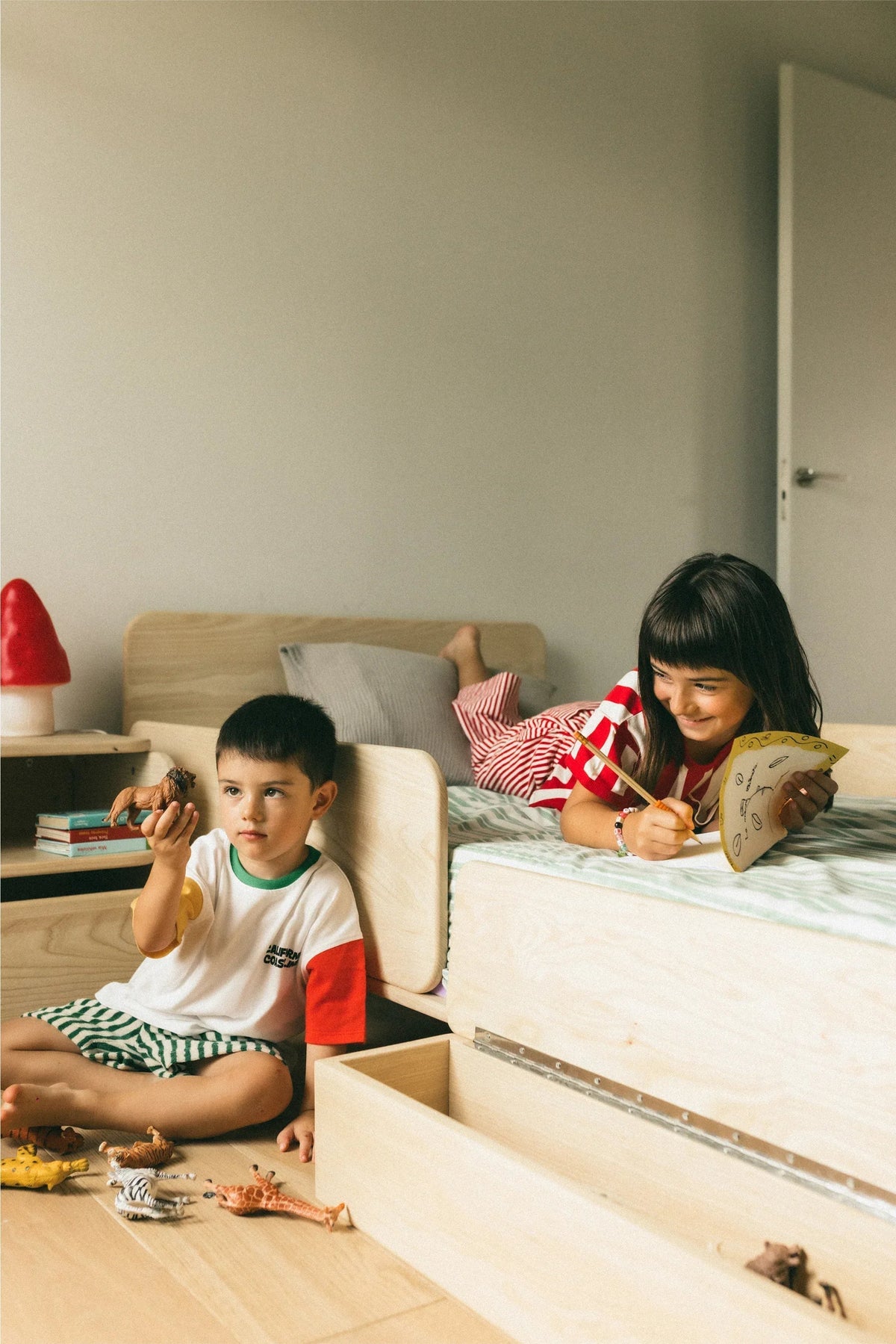
A Montessori bed is a low bed, without bars, that lets the child get in and out on their own without an adult's help. The idea comes from Maria Montessori's educational method: giving the child a prepared environment where they can move freely, develop independence and explore the space at their own pace. Applied to the bedroom, that means a bed that doesn't shut them in, that sits close to the floor and that invites movement instead of limiting it.
But there is something almost nobody tells you when you look for a Montessori bed: the design matters, and the material matters even more. A low bed made of particleboard is not the same as a low bed made of solid wood, even if both are called the same thing.
Which Montessori bed to choose by age: Mimoa or Nono
At Circulari we have two solid wood Montessori beds, designed for two different moments:
| Mimoa | Nono | |
|---|---|---|
| Approximate age | 2 to 6 years | 3 to 10 years |
| Size | 140 cm bed | For a 90 × 190 or 200 cm mattress |
| Protection | Side rail | Integrated sides |
| Material | Solid pine or ash | Solid pine or ash |
| Price | From €599 | From €799 |
The Mimoa is the option for the move from cot to bed, from age 2. The Nono is the bed that stays for many years: it goes with the child from about 3 to 10. If you hesitate between the two, think about how much space you have and whether you prefer a bed designed for the early years or one that lasts the whole childhood.

How high off the floor should a Montessori bed be?
A pure Montessori bed is at floor level —literally the mattress on the floor or on a minimal base— so that even a baby of a few months can roll out of it without danger. As the child grows, the height can increase slightly without losing the essence of the concept.
In practice, most Montessori beds on the market are between 10 and 20 cm from the floor. That height keeps the key benefits —the child can get in and out alone, an accidental fall has no serious consequences— without giving up the comfort of having the mattress raised away from the cold of the floor and with better ventilation.
Circulari's Nono bed is 15 cm from the floor. It is a junior bed in solid wood —pine or ash— with integrated sides that provide protection and stability without shutting the child in. It is designed for the stage from about 3 to 10 years, when the child has outgrown the cot but needs a space that respects their scale and independence.
Why the Montessori method puts the bedroom at the centre
Maria Montessori developed her method in the early 20th century by observing how children learn best when the environment is adapted to them, not the other way round. In the bedroom, that has concrete implications:
- The low bed allows real independence. A child who can get up alone when they wake doesn't have to wait for an adult. They learn to manage their time, space and routines from a very young age.
- No bars, no cage. The traditional cot shuts the child in a space they can't leave. The Montessori bed gives free access to the floor, where they can play, move and explore when they wake up.
- The floor is part of the play environment. With a low bed, the bedroom floor becomes a natural extension of the resting space. A big rug, a few books within reach: the bedroom stops being just a place to sleep.
From what age is a Montessori bed used?
It depends on the design. Floor-level beds can be used from the first months —some parents use them from birth instead of a cot. Low beds such as the Mimoa (from age 2) or the Nono (from age 3) are designed for the moment the child moves from cot to bed, usually between 2 and 3 years old.
There is no exact age. The clearest sign is when the child starts trying to get out of the cot on their own. At that point, the low bed is safer than the cot —because it removes the risk of falling from a height— and more suitable than a regular bed, because the child can manage it alone.
Why the material of a Montessori bed matters more than it seems
A low Montessori bed made of particleboard and one made of solid wood have the same design. But they are not the same product.
Particleboard and MDF panels contain urea-formaldehyde resins that are slowly released into the air for years. In a well-ventilated child's bedroom the impact is limited. In the room of a child who sleeps 10 hours a few centimetres from that surface, the exposure is prolonged and constant. VOCs and formaldehyde are associated with respiratory irritation, allergies and, with intense exposure, more serious effects.
Solid wood doesn't have this problem. It contains no synthetic resins, doesn't emit formaldehyde and its natural compounds —especially in pine— have documented antimicrobial properties. Water-based finishes without polyurethanes complete a piece of furniture that, literally, emits nothing that shouldn't be in the room where your child sleeps.
There is another practical reason: solid wood stands up to use. A low bed lives on the floor —literally— and is exposed to knocks, play and jumping. Particleboard chips, swells with humidity and can't be repaired. Solid wood ages well, can be sanded and touched up, and can have a second life when your child outgrows it.
Montessori bed vs. cot: when to make the switch
The clearest sign to switch from cot to low bed is not age but behaviour: when the child starts trying to climb and get out of the cot, it's time. Staying in a high cot after that point is more dangerous than moving to a low bed early.
The transition is usually easier than parents expect. The child already knows their room and has their routines. What changes is that they now have more freedom —and that freedom, well prepared, strengthens independence instead of creating insecurity.
A few tips for the transition:
- Prepare the floor: a big rug around the bed cushions any accidental roll.
- Put favourite books and toys at floor level, reachable from the bed.
- The first nights may need the child to explore the new space before falling asleep. It's normal and it passes.
- If the room has dangerous items within reach, secure them before making the move.
And if the room is small or two siblings share it, see how to arrange the furniture in a small or shared kids' room.

What Circulari does differently
The Mimoa and Nono beds are made of solid pine or ash in our Barcelona workshop, with water-based finishes without polyurethanes or VOCs. The sides give stability and a feeling of a space of their own without bars that shut the child in. Each one is designed for its stage —the Mimoa from 2 to 6 years, the Nono from 3 to 10—: not a compromise that works for everything, but the exact piece for that moment.
And when that moment passes, you can return it to us. We collect it from your home, restore it in the workshop and give you back 30% of its value as credit towards the next piece of furniture, or 15% in cash. The circle closes: your child moves on to the next stage, and the planet doesn't get one more piece of furniture in a landfill.
If you want to understand better how this system works before buying, we explain it here.
See the Mimoa bed → · See the Nono bed →
Frequently asked questions
From what age can a Montessori bed be used?
It depends on the model. Floor-level beds are used from the first months; low beds such as the Mimoa (from age 2) or the Nono (from age 3) are for the move from cot to bed.
How high should a Montessori bed be?
Between 10 and 20 cm from the floor is usual: the child gets in and out alone and an accidental fall has no serious consequences. The Nono is 15 cm high.
How much does a solid wood Montessori bed cost?
At Circulari, the Mimoa starts at €599 and the Nono at €799. And you can return it when your child grows and recover up to 30% of its value.
When should you switch from the cot to a Montessori bed?
When the child starts trying to climb and get out of the cot. Staying in a high cot after that point is more dangerous than moving earlier to a low bed.
Why is a solid wood Montessori bed better?
It has no formaldehyde resins like particleboard or MDF, it stands up to knocks and play, and it can be sanded and touched up instead of thrown away.
Solid wood beds and cots
Cots and beds made in Barcelona from solid wood with water-based, VOC-free finishes, designed to go with every stage of sleep.
Shop beds and cots🎁 First order? Subscribe and get your welcome discount →
Share: